A customer needs a garage door spring replaced. In 2019 they typed "garage door repair near me" into Google, scrolled past three ads, opened four tabs, and compared them.
In 2026 they open ChatGPT and ask: "My garage door spring broke. Who should I call in Oklahoma City and what should it cost?"
They get one answer. A name, a price range, a reason. Then they call that name.
If it's your name, you just won a customer who arrives pre-sold — they already know your pricing, your service area, and why you're the right call. If it's your competitor's name, you never knew the conversation happened. There's no impression in your analytics for a search you weren't part of.
That's the whole thing. That's why this matters now.

The numbers that should end the debate
Two facts, both from 2026, both independently measured.
More than half of Americans use AI chatbots weekly. An SSRS panel fielded in February 2026 put weekly usage at 52%. Pew Research's Americans and AI 2026 report, published in June, found 49% of US adults using AI chatbots — with ChatGPT use among US adults climbing from 18% in 2023, to 34% in 2025, to 44% in 2026. About a quarter of Americans now use chatbots daily.
This is not an early-adopter demographic anymore. It's your customers.
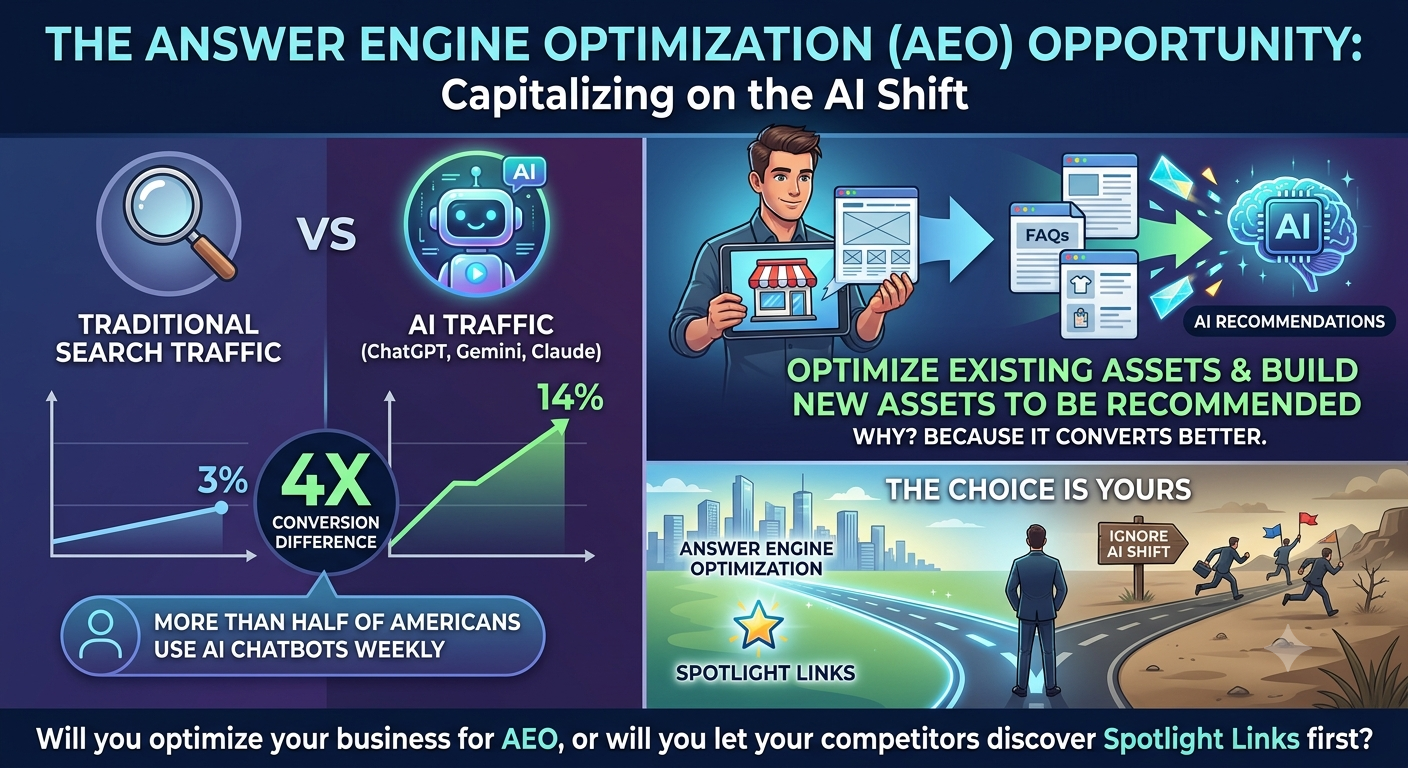
That traffic converts at a multiple of traditional search. RankScience measured AI search traffic converting at 14.2% against traditional organic's 2.8% — a 5.1× premium. Seer Interactive's multi-vertical study found ChatGPT referrals converting at 15.9% versus Google organic at 1.76% — 9×. Semrush's 2026 cross-industry data puts the average at 4.4×. Ahrefs found AI visitors making up 0.5% of traffic while driving 12.1% of signups.
Different methodologies, different verticals, same direction every time.
Why AI traffic converts so much better
It isn't magic, and understanding the mechanism tells you exactly what to optimize.
A Google search result is a guess. Ten blue links, and the searcher does the qualifying work — reading, comparing, eliminating. Most of them bounce. That's why 3% is a normal conversion rate; the other 97% were never really in the market for you specifically.
An AI answer is a recommendation. By the time someone clicks through to your site, the engine has already answered their question, compared their options, and named you as the one worth contacting. The qualifying happened before the click. They arrive further down the funnel than any Google visitor has ever arrived.
You're not buying more traffic. You're buying traffic that already decided.
The honest caveat, because credibility is the point
Here's where most agencies would stop and let you assume the 5× applies to you. It might not.
The premium is enormous for considered purchases — anything where a person needs information before choosing. Home services, contractors, medical and optical practices, specialty retail, B2B. Exactly the businesses that live or die on being the trusted recommendation.
The premium is small or absent for commodity ecommerce. Visibility Labs' study of 94 ecommerce brands found ChatGPT referrals converting at 1.81% versus 1.39% for non-branded organic — a real but modest 1.3× lift. One large-scale study found organic outperforming ChatGPT referrals by 13% for pure transactional ecommerce. If someone's buying a phone case, they don't need a recommendation engine.
We come clean before beginning work. A strategy built on a number that doesn't apply to your business is a strategy that fails in month. If you're a garage door company, a construction firm, a prescription shop, or an ice cream shop with something worth explaining — the premium is real and it's yours to take. If you're dropshipping commodity goods, we leverage your assets for AEO, we'd simply say, someone can do a better job than us. If yours is a nail saloon, let us visit you.
SEO, AEO, GEO — three acronyms, one system
They're not competing strategies. They're layers, and most businesses are missing two of them.
SEO — Search Engine Optimization. Getting ranked in traditional search results. Still necessary, still not sufficient. It's the foundation the other two stand on, because engines that can't crawl and understand your site can't cite it either.
AEO — Answer Engine Optimization. Getting your content quoted when an AI engine answers a question. This means structuring content as direct answers to real questions, with specific facts — real prices, real timelines, real service areas — stated plainly in the first sentence. Engines don't cite marketing copy. They cite the page that actually answered the question.
GEO — Generative Engine Optimization. Making the generative systems recognize your business as a real, trustworthy, citable entity. Consistent name and contact details everywhere. Verifiable business registration. Real reviews from real people. Structured data that tells machines precisely what you are, where you operate, and what you do.
Run separately, each one underperforms. Run as a single architecture — which is how we build — they compound.
Why brick-and-mortar businesses win biggest
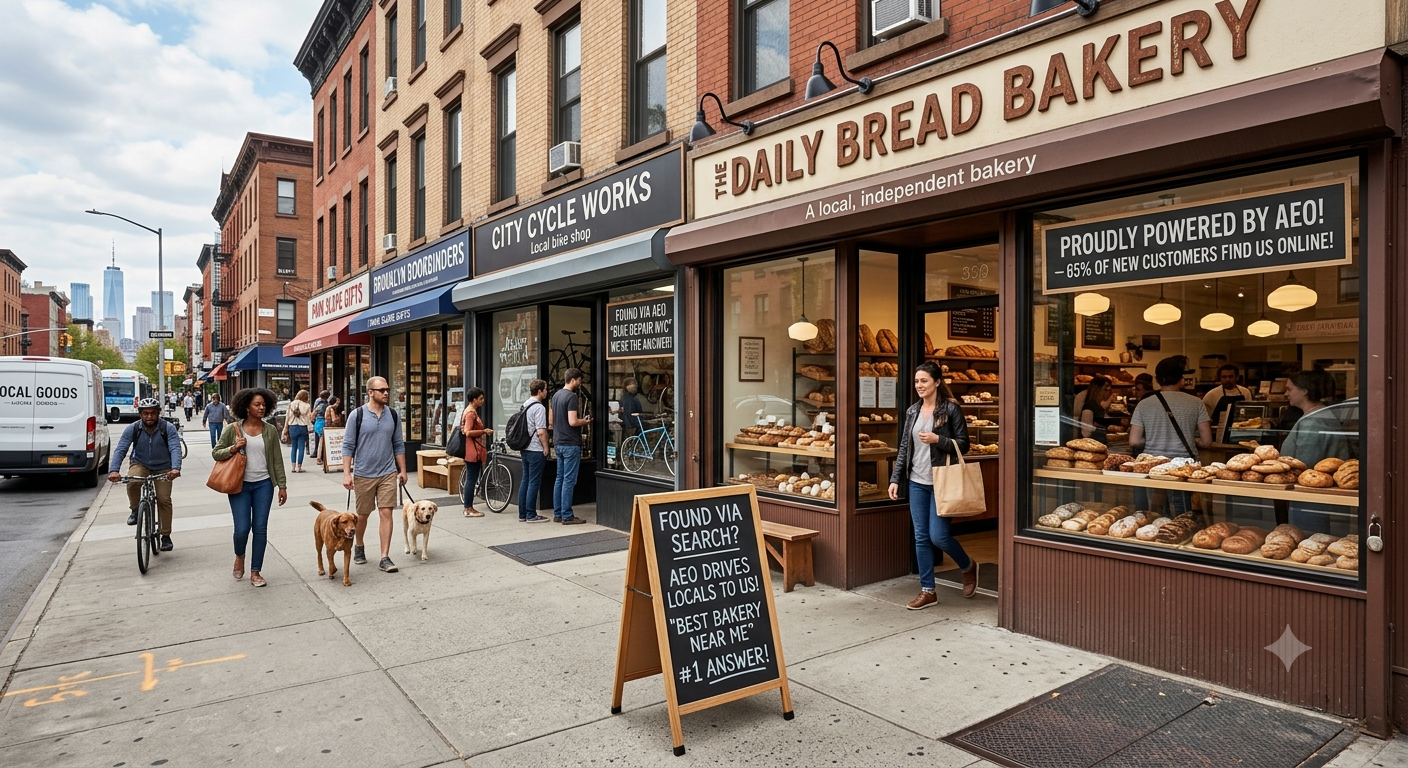
Most of our work is with physical businesses — construction, garage doors, prescription shops, dessert and ice cream shops. Not because we won't take anyone else. Because that's where the gap between opportunity and execution is widest.
A local service business has something a national brand can't manufacture: genuine, specific, local expertise. What a spring replacement actually costs in this city. Which repairs are urgent and which can wait. What the weather here does to equipment.
That's precisely the material AI engines are hungry for — specific, factual, locally-grounded answers. And almost none of it is written down anywhere.
Meanwhile the national franchise with the decade-old domain has generic content and a marketing budget. In the old ten-blue-links world, budget won. In an answer engine, the page that actually answers the question wins — and a one-technician shop that documents its expertise properly can beat a franchise that never bothered.
That window is open right now. It will not stay open, because eventually everyone figures this out.
What this looks like when we actually do it
Open Sesame Garages is a garage door company in Oklahoma City run by a young entrepreneur named Abdul. When we started, he had real skills, five-star customers, and essentially no web presence. We built the whole thing: the site, the infrastructure, the analytics, the content system, the search architecture.
Today, ask an AI-powered search a garage door question about OKC and the answer comes back quoting his site verbatim — the $150–$350 spring replacement range, the 24/7 coverage across Edmond, Norman, Moore, and Midwest City, the fully-stocked trucks. Word for word, from FAQ content we wrote and structured for exactly that purpose.
The site isn't just ranking in the answer. It's writing the answer.
That's a one-technician garage door shop being recommended by the same systems your customers are asking right now. It didn't take a national brand budget. It took building the thing correctly from day one.
How we execute it
The same architecture every time, adapted to your business:
- Audit what you already have. Most businesses have assets that are one restructure away from being citable. We find those first — it's the fastest return available.
- Rebuild your existing assets.
- Establish the entity.
- Build the missing assets. What can't you see with your vision, we see it — and we build it.
- Measure and expand. Implement state of the art analytics and tracking mechanisms to deliver on quantity.
None of it is a trick. There is no prompt to hack, no schema to game. It's building a business that genuinely deserves to be recommended, then making sure the machines can read it.
The choice, stated plainly
More than half of your customers are asking AI chatbots questions every week. When they ask about what you sell, an answer comes back with somebody's name in it.
Today, in most local markets, that name is nobody's — the engines are stitching together generic content because no local business has done the work. That's a vacuum, and vacuums close.
Will you optimize your business for the way people actually search now? Or will your competitor find Spotlight Links first?
We'd rather it was you. But we'll build it for whoever calls.
Ready to find out where you stand? We'll audit your existing assets and show you exactly what's citable, what isn't, and what it would take. Book a strategy call — the first four booked from this site are free.
Sources
- SSRS, Half of Americans Using AI Chat on Weekly Basis (February 2026 panel)
- Pew Research Center, Americans and AI 2026: Chatbots, Smart Devices and Views on Impact (June 17, 2026)
- RankScience, AI search traffic conversion analysis, 2026
- Seer Interactive, multi-vertical ChatGPT referral conversion study, 2026
- Semrush, 2026 cross-industry AI traffic conversion data
- Ahrefs, Does AI Search Traffic Convert Better Than Traditional Search, 2026